Resource Center

Explore our collection of articles, project updates, research summaries, and technical resources covering vertical solar, agrivoltaics, and the evolving solar industry.

California produces nearly half of all U.S. vegetables and more than three-quarters of U.S. fruits and nuts, according to the CDFA. Today, moving that food from farms and packing facilities to distribution centers, ports, and markets requires a significant transportation network. One that runs predominantly on diesel.

Shifting this transportation network from diesel to electricity could have significant environmental and public-health benefits. A recent Southern California study found that battery-electric trucks produced approximately 75% fewer well-to-wheel greenhouse gas emissions than comparable diesel trucks, while eliminating tailpipe emissions such as nitrogen oxides (NOx) and particulate matter. These pollutants have been linked to respiratory and cardiovascular disease, as well as premature death.

But electrifying heavy-duty transportation also creates substantial new electricity demand. As electric trucks such as the Tesla Semi enter commercial fleets, larger questions appear: Where will that electricity come from, and could innovative solar infrastructure along transportation lines become part of the solution?

The Energy Economics Can Be Compelling

Consider a simplified example of a heavy-duty truck operating predictable routes in California’s Central Valley.

If a truck travels approximately 300 miles per day for 250 days each year, it covers about 75,000 miles annually. Based on Tesla’s claim that the electric Class 8 truck requires approximately 2 kWh per mile, including allowances for charging losses and operating conditions, it would consume roughly 150 MWh of electricity per year. California’s average electricity prices during the first half of 2026 were approximately $0.20/kWh for industrial customers and $0.26/kWh for commercial customers, according to the U.S. Energy Information Administration. That represents approximately $30,000–$39,000 per year in electricity costs.

A comparable diesel tractor averaging 6.3 mpg would consume approximately 11,900 gallons of diesel annually over the same 75,000 miles. At California’s August 2026 average on-highway diesel price of approximately $7.04 per gallon, annual fuel costs would approach $84,000. Under these assumptions, electrification could save roughly $45,000–$54,000 per truck per year in energy costs alone.

Actual economics will vary considerably with diesel and electricity prices, vehicle efficiency, charging losses, demand charges, payload, route conditions, and other factors. But the simplified calculation illustrates something important: for predictable agricultural trucking routes, the cost of electricity itself may not be the biggest obstacle. The greater challenge may be ensuring sufficient electricity is available along delivery routes and at the time trucks need to charge.

Truck Electrification Means More Energy Infrastructure

Heavy-duty charging requires infrastructure on an entirely different scale than passenger EV charging. A packing facility, distribution center, or trucking depot operating dozens of electric trucks could require several megawatts of charging capacity. In rural areas, delivering that power may require utility upgrades, transformers, switchgear and other costly infrastructure.

This makes predictable agricultural routes particularly interesting. A truck that travels between a packing facility and distribution center and returns to the same yard each day has something an unpredictable long-haul truck does not: a known place and time to charge.

That opens the door to pairing charging with onsite generation and energy storage. Rather than relying solely on the traditional model of grid-supplied charging, facilities could move toward a more integrated approach where renewable energy, such as solar, is paired with battery storage and managed charging.
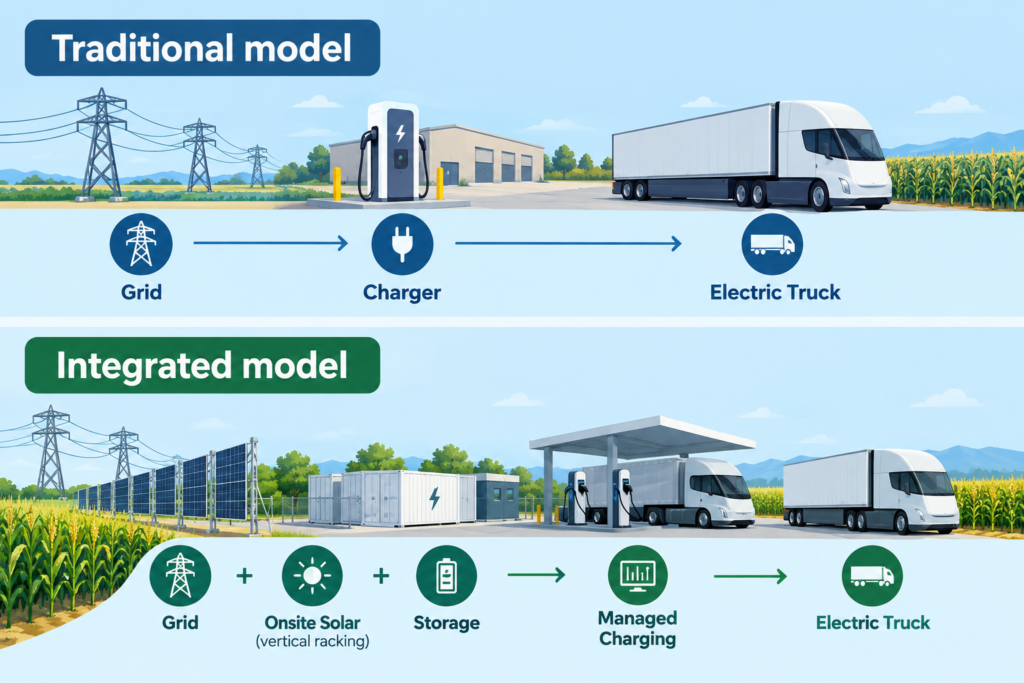
This allows electricity generated onsite to be stored when production exceeds immediate demand and delivered later when trucks need to charge. In addition to increasing the use of onsite renewable energy, storage can help reduce peak demand on the grid, manage demand charges, and smooth large charging loads that might otherwise require substantial utility infrastructure upgrades. For fleet operators, the result could be greater control over when and how electricity is purchased, generated, stored, and ultimately delivered to vehicles.

Where Does Highway Solar Fit In?

While direct connections could be technically possible in certain locations, there are significant practical challenges. Electricity generated alongside a highway is not automatically available to a truck charger several miles away. Interconnection, ownership, utility requirements, DOT right-of-way restrictions, and the mismatch between variable solar generation and megawatt-scale truck charging all affect whether and how that electricity can be used.

Highway solar should therefore be viewed more broadly as a potential distributed generation resource within an increasingly electrified transportation system, rather than a direct connection between a particular solar array and a particular truck.

The Role of Dual-Use Solar

Conventional ground-mounted solar can contribute to this energy mix, but in agricultural regions such as the central valley, arable land is a valuable and finite resource. Dedicating additional acreage exclusively to energy production can create competition between renewable energy development and food production.

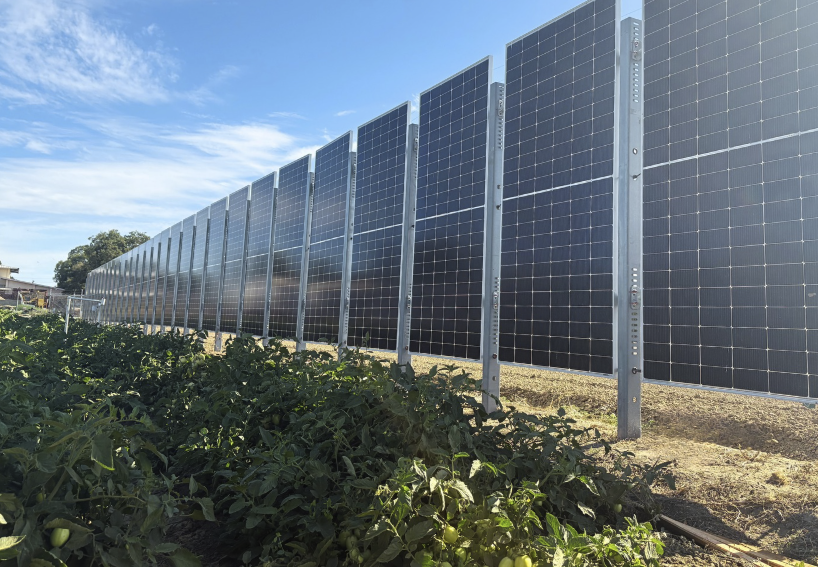
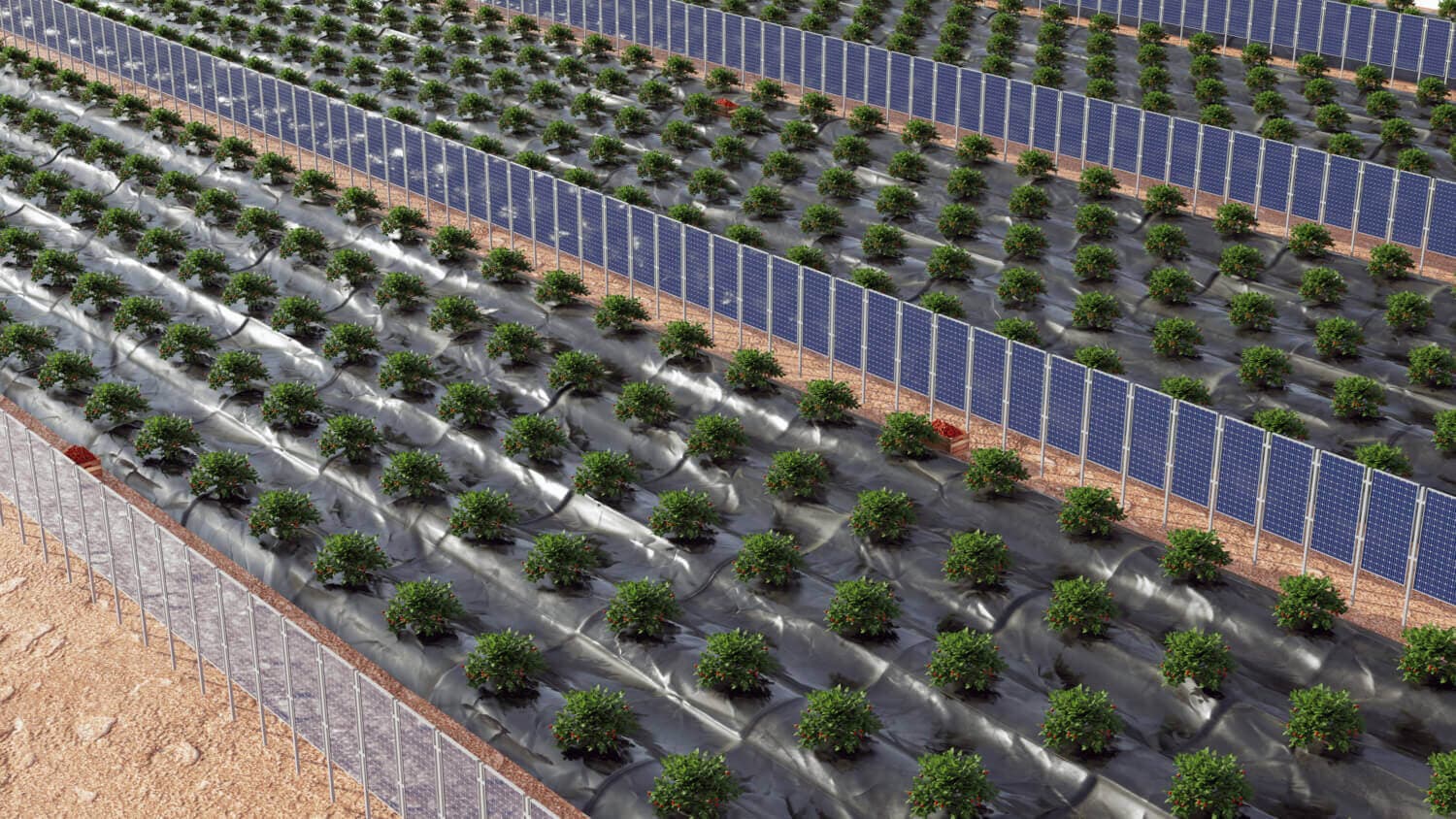
That is where dual-use energy systems with a small footprint, such as vertical PV, enter the conversation. Rather than replacing the existing use of the land, vertical solar can be integrated along agricultural plots as wind breaks, property boundaries as fencing, and other narrow or underutilized spaces. In the right applications, these systems can add renewable generation without taking working land out of production.

Conceptual illustration generated using AI.

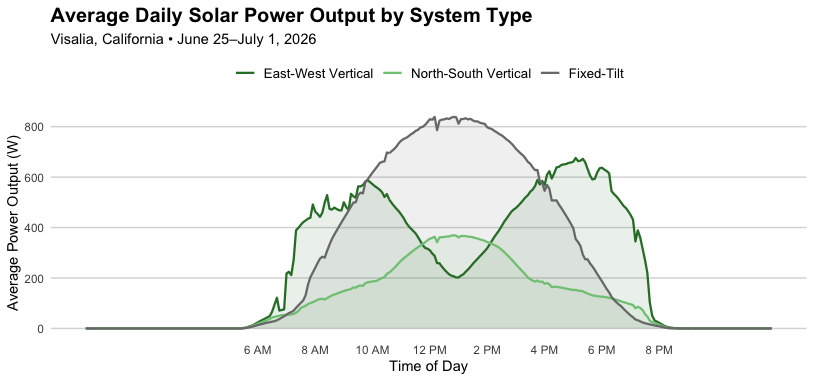
Vertical bifacial PV also has a different daily production profile than conventional south-facing fixed-tilt solar. An east-west-facing vertical array tends to produce more strongly during the morning and afternoon, with lower production around solar noon relative to a traditional array. For transportation facilities, that profile could have advantages. Trucks returning to a depot later in the day  may begin charging during afternoon or evening hours. West-facing surfaces of a vertical bifacial system can continue generating later in the day, potentially placing more solar production closer to those charging periods.

That does not eliminate the need for the grid or battery storage. Heavy-duty trucks require large amounts of energy, and charging schedules will rarely align perfectly with solar generation. But it demonstrates why transportation solar should be evaluated on more than annual kilowatt-hours alone. 

The Future of Property Lines

California’s Central Valley offers a compelling setting for transportation electrification: high diesel costs, abundant solar resources, and predictable and highly frequented freight routes. As trucks increasingly shift from diesel to electricity, the infrastructure that supports those routes will need to evolve as well. That creates an opportunity to look beyond conventional solar sites and consider spaces already present in the agricultural and transportation landscape.

By finding productive uses for the spaces between farms, freight facilities, and freeways, the Central Valley could help demonstrate how transportation electrification and distributed solar generation can grow together.

Annual energy production has long been the primary metric used to compare photovoltaic (PV) configurations. In general, configurations that produce more kilowatt-hours are assumed to perform better. However, electricity is not worth the same amount throughout the day.

Many utilities now use Time-of-Use (TOU) rate structures, where the value of electricity varies by time of day. Under these tariffs, electricity generated during periods of high demand, which is typically in the late afternoon and evening, has a higher economic value than electricity generated during lower-priced periods.

As solar deployment has increased, midday electricity has become increasingly abundant in many markets. In regions such as California, this can reduce the value of electricity generated around noon while increasing the value of generation later in the day. As a result, a PV configuration that produces less total energy may still generate greater economic value if its generation profile better aligns with higher-value periods.

As electricity markets continue to evolve, evaluating PV configurations requires considering not only how much electricity is produced, but also when it is produced.


How Vertical East-West Configurations Differ

Conventional fixed-tilt PV configurations are designed to maximize annual energy production, with generation peaking around solar noon when solar irradiance is highest.

Vertical east-west bifacial configurations produce a different generation profile. Because bifacial modules generate electricity from both faces, the east-facing side captures more morning sunlight while the west-facing side produces more electricity later in the day. This shifts generation away from midday and creates two distinct production peaks—one in the morning and one in the late afternoon.

Measuring the Value of Electricity

To better understand how generation timing affects economic value, we evaluated measured production data from three PV configurations using a representative 2026 PG&E Time-of-Use (TOU) tariff. This allowed us to compare not only how much electricity each configuration produced, but also when it was produced and the corresponding value of that electricity.

The three configurations included an east-west vertical system, a north-south vertical system, and a 20° fixed-tilt system. Each system used identical PV modules and microinverters.

The analysis sought to answer three questions:

  • Which PV configuration produces the most electricity?
  • Which PV configuration generates the greatest share of its electricity during the highest-value TOU periods?
  • Which PV configuration provides the greatest overall economic value under a TOU rate structure?

Initial Findings

Measured field data collected over five representative days in June 2026 revealed a clear difference between energy production and energy value.

Although the fixed-tilt system produced the most electricity, the east-west vertical system generated the greatest economic value. This difference was driven by generation timing. Because the east-west vertical configuration produced a larger share of its electricity during higher-value TOU periods, each kilowatt-hour generated was worth more on average.

  • Fixed Tilt: Produced the most electricity (32.2 kWh), but only 14.3% of its energy was generated during peak-rate hours. Its average electricity value was 34.3¢/kWh, which serves as the baseline for comparison.

  • East-West Vertical: Produced slightly less electricity (29.2 kWh), approximately 9.3% below fixed tilt, but generated 35.4% of its energy during peak-rate hours. As a result, its electricity averaged 40.6¢/kWh, which is approximately 18% more value per kilowatt-hour than the fixed-tilt system.

  • North-South Vertical: Produced substantially less electricity (13.3 kWh). Its average electricity value (35.4¢/kWh) was slightly higher than fixed tilt, but its lower energy production resulted in the lowest overall economic value ($4.71).

The lower performance of the north-south vertical configuration is consistent with the reduced direct solar exposure expected for north-south-oriented vertical systems during summer. Monitoring is ongoing to evaluate seasonal performance throughout the year.

Overall, these initial results highlight that the configuration that produced the most electricity was not the configuration that produced the greatest economic value. Under Time-of-Use pricing, when electricity is generated can be just as important as how much is generated.

Why This Matters

These findings illustrate that maximizing annual energy production does not necessarily maximize economic value.

In regions where solar energy is well established, midday electricity is becoming increasingly abundant, reducing its value during certain periods of the year. At the same time, electricity demand, and often electricity prices, remain higher during the late afternoon and early evening. Under these conditions, a generation profile that shifts production away from solar noon may provide greater economic value, even if total energy production is lower.

As Time-of-Use pricing becomes more common, evaluating PV configurations requires considering both how much electricity is generated and the time at which it is generated. Depending on the utility tariff and site characteristics, a generation profile that better aligns with higher-value periods may provide benefits beyond project revenue, including reduced grid stress, lower reliance on peaker plants, and improved utilization of renewable generation.

Project Considerations

These results do not indicate that vertical east-west PV configurations will always provide greater economic value. Performance depends on several project-specific factors, including:

  • Utility Time-of-Use tariff structure
  • Geographic location
  • Seasonality and weather
  • PV system design
  • On-site electricity consumption versus grid export

Utilities with relatively small differences between peak and off-peak electricity prices may show only modest economic differences between PV configurations. Conversely, tariffs with larger price differentials may place greater value on generation that occurs outside the midday production peak.

Applications with significant morning or late-afternoon electricity demand may benefit most from this generation profile, including:

  • Agricultural irrigation operating under TOU tariffs
  • Farms with electrically driven water pumps
  • Commercial or industrial facilities with morning and evening demand peaks
  • Projects seeking to reduce demand charges
  • PV systems paired with battery energy storage

Conclusion

Annual energy production remains an important measure of PV performance, but it does not always capture the full economic value of a system. As Time-of-Use electricity pricing becomes more widespread, generation timing is becoming an increasingly important consideration alongside total energy production. This analysis demonstrates that, under the representative utility tariff evaluated, the vertical east-west bifacial configuration produced greater economic value despite generating less total electricity than the conventional fixed-tilt configuration. Evaluating both energy production and energy value provides a more complete basis for comparing PV configurations and selecting the most appropriate solution for a given project.


Analysis based on production data collected from Sunzaun’s Central Valley, California test site. Results represent an initial five-day analysis from June and should not be generalized across all projects or seasons. The system configurations and utility rate structures may vary depending on location, weather, utility tariffs, and project-specific design.


About the Author

Anika conducted the data analysis and prepared this article. She is part of the Business Development team at Sunzaun, where she focuses on vertical solar technologies, agrivoltaics, and research that supports practical solar deployment.

How Bodhi Hot Yoga & Fitness in San Rafael, California became the first business in the United States to install a vertical bifacial solar system in an urban environment — and why they’d do it all over again.

“We’re the first, I believe — the first in an urban environment to do it. In the US.”
— Bo Keeve, Co-owner, Bodhi Hot Yoga & Fitness

When most people picture a solar installation, they imagine rooftop panels or open fields. Bodhi Hot Yoga & Fitness in central San Rafael, California had neither to offer. What they had was a parking lot perimeter, an electricity bill climbing past $2,000 a month, and a relationship with Sunzaun built on years of shared yoga classes. That combination led to something no urban business in the United States had done before: a vertical bifacial solar installation right in the heart of the city.

About Bodhi Hot Yoga
Bodhi Hot Yoga & Fitness is a family-owned studio run by mother and son Katie and Bo Keeve, with Katie’s husband Damon supporting behind the scenes. Coming up on their second anniversary, Bodhi offers hot yoga, Pilates, and a range of fitness classes using infrared heating panels and added humidity — making it one of the more energy-intensive businesses on its block. The studio was built on four core values: community, boldness, curiosity, and adventurous fun. Those values didn’t just hang on a wall during the solar process. They guided every decision.

The Challenge
As an all-electric building with no gas on the property, Bodhi’s energy costs are entirely tied to the grid. In two years of operation, their monthly electricity bill more than doubled — from $500–800 at launch to over $2,000 as class schedules grew and demand increased. Solar had always been on their radar, but the rooftop was structurally complex and every parking space was too valuable to sacrifice. Conventional solar simply didn’t fit.

The Solution
Sunzaun proposed something most people had never seen outside of Europe: 16 vertical bifacial panels, each standing eight to nine feet tall, installed along the perimeter of Bodhi’s back parking lot. Bifacial panels capture sunlight from both sides — direct irradiance on one face, reflected and diffuse light on the other — making vertical installation viable without a south-facing rooftop. The design also included a whitened wall section behind the panels to test whether surface reflection could further increase energy yield, a detail that will inform future urban installations. Bodhi Hot Yoga became the first business in the United States to install this type of system in an urban environment.

“They made it easy, they made it affordable, and it’s really fun. I would 100% recommend it.” — Katie Egan, Co-owner

The Construction Process

Katie braced for a month of disruption. The reality was eight to ten days. The Sunzaun crew managed city permitting, utility coordination, and site logistics from start to finish, with no significant involvement required from the owners. Workers kept the site clean daily, attended yoga classes during the build, and Sunzaun co-founder Helge Biernath even brought brewed beer for studio clients inconvenienced by the temporary parking closure. No parking spaces were lost. The bollards added around the panel bases looked, in Katie’s words, “phenomenal.” Bo, who had worried the panels would look industrial and out of place, called the finished result “really cool” and said it fits the lot like a modern perimeter fence.

The Results
The system is newly operational and full-year data will tell the definitive story, but projections are clear: $5,000–$10,000 in estimated annual savings on electricity. Zero parking spaces lost. Eight to ten days from start to finish. And a visible, working statement about who Bodhi is as a business — one that clients see every time they pull into the lot.

“Come do hot yoga, support, feel good, enjoy your day. Zero guilt.” — Beau Keeve

San Rafael is growing fast — new buildings rising across the street, eight and seventeen stories high. In that context, a small family-run studio choosing vertical solar isn’t just a financial decision. It’s a declaration about what kind of neighbor they intend to be. For other urban businesses watching their electricity bills climb with no rooftop solution in sight, Bodhi Hot Yoga is proof that a different path exists.

Is vertical solar right for your property?

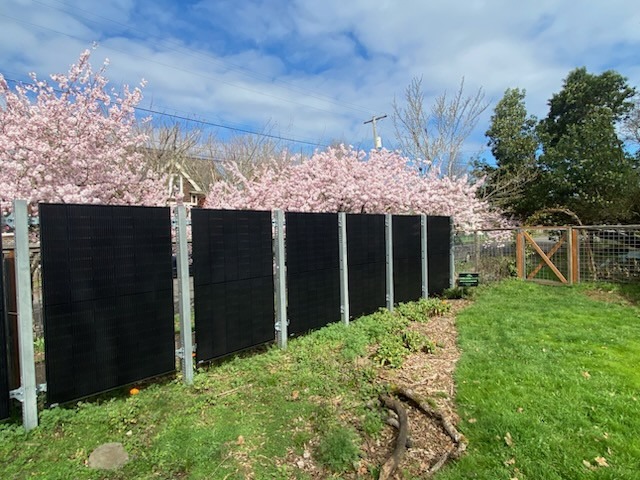
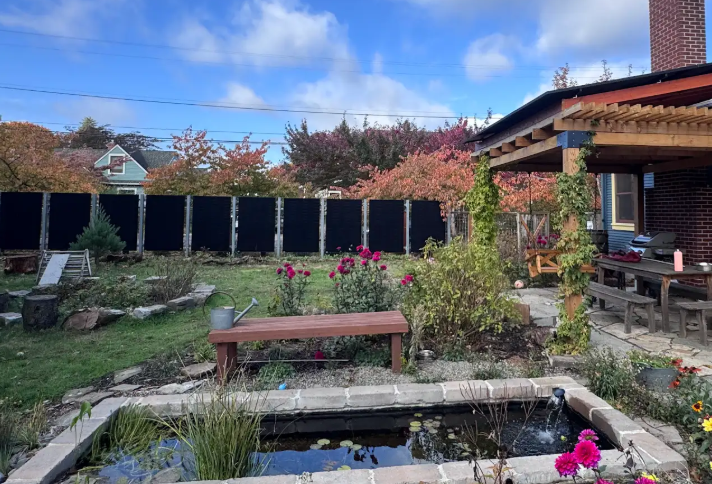
We are thrilled to announce that in July 2025, Sunzaun reached a major milestone! In partnership with Cascade Solar, we completed our very first residential solar fence in Portland, Oregon. This 5.74 kW project features 11 sleek modules, one of the first of its kind in the United States.

The Science Behind the Shine: Technical Advantages

What makes vertical solar panels so effective? Unlike traditional horizontal panels that peak in production only when the sun is directly overhead, vertical bifacial modules capture sunlight from both sides. In regions like the Pacific Northwest, where the sun sits lower in the sky for much of the year, a south-oriented vertical system can significantly optimize energy yield throughout late fall, winter, and early spring. Conversationally, east- and west-facing modules perform best in the summer months. This is the benefit of having perpendicular fencing that allows for a well-rounded energy production curve

Furthermore, vertical panels are naturally more resilient. Their upright position means they shed snow effortlessly and accumulate far less dust and debris than roof-mounted systems. This reduction in “soiling” ensures the panels maintain peak efficiency with minimal maintenance, even during Oregon’s rainy seasons.

Why a solar fence? As energy prices continue to climb, homeowners are looking for smarter ways to power their lives. While rooftop solar is a fantastic option, it isn’t always the perfect fit for every home due to roof orientation or shading. That’s where the “dual-use” revolution comes in. By turning a standard property boundary into a clean energy generator, homeowners can enjoy the benefits of solar without compromising their roofline.

Seamless Integration: A Homeowner’s Dream

For many homeowners, the most compelling reason to go vertical is the installation process. Roof-mounted solar often requires a detailed structural assessment and, in some cases, costly roof reinforcements before installation can even begin. A Sunzaun vertical solar fence, however, is installed as a standalone structure along your property boundary. That means no drilling into your shingles, no modifications to your roof, and no interference with your home’s existing architecture.

Another often-overlooked advantage is long-term maintenance. Roofs don’t last forever, and when it’s time to replace or repair one, rooftop solar panels typically need to be removed and reinstalled; a process that can add thousands of dollars to the cost of roofing work. Because a vertical solar fence is independent of your home infrastructure, roof repairs can be completed without ever touching your solar system, avoiding additional labor costs.

The installation is faster, less invasive, and serves a double purpose: providing privacy and security for your yard while simultaneously slashing your utility bills. It’s a true “plug-and-play” solution for the modern sustainable home.

This project is just the beginning of a useful trend that maximizes space and efficiency. We are incredibly excited to continue our journey with the Cascade Solar team and can’t wait to see what the future of vertical solar brings to neighborhoods across the country!

Ready to Power Your Perimeter?

The era of the smart fence is here, and we want to help you be a part of it. Whether you’re looking to supplement your existing energy source or are just starting your solar journey, vertical solutions offer a unique blend of style and substance.

Are you curious about how a vertical solar fence would look on your property? Reach out to our team today to learn more about our technology and get a custom consultation. Let’s build a brighter, greener future together!

As the world increasingly turns to renewable energy sources, solar power remains at the forefront of this green revolution. However, traditional ground-mounted solar panels (GM-PV) come with a significant trade-off: they require large swathes of land that could otherwise be used for farming. With the availability of arable farmland shrinking—down by 49% per person globally—this competition between energy production and agricultural space is becoming more pronounced. Agri-PV (agricultural photovoltaics), is an innovative solution that promises to harmonize the needs of both farmers and the renewable energy sector.

The Dilemma of Ground-Mounted Solar Panels

GM-PV systems are undeniably effective in harnessing solar energy, but they pose a challenge when it comes to land use. Farmland is increasingly in demand for growing crops to feed a growing global population. As the amount of arable land per person decreases, the expansion of traditional GM-PV systems often means taking away land that could be used to grow food. This creates a tension where solar energy and agriculture are pitted against each other, rather than working together.

Introducing Agri-PV: A Harmonious Solution

Agri-PV represents a groundbreaking approach to integrating solar energy with agriculture. Unlike traditional GM-PV, which sits on the ground and competes with farming, Agri-PV systems are designed to coexist with crops on the same land. Here’s how Agri-PV is transforming the landscape:

  1. Dual Use of Land: By installing solar panels vertically next to crops, Agri-PV systems make it possible to produce renewable energy without displacing agricultural activities. This dual-use model maximizes land efficiency and addresses the pressing issue of reduced farmland availability.
  2. Climate Resilience for Farmers: One of the most significant benefits of Agri-PV is its ability to help farmers cope with extreme weather conditions. Solar panels provide much-needed shade, which reduces water loss due to evaporation and protects plants from excessive heat and wind. This not only helps in maintaining crop health but also mitigates the effects of drought and other climate-related challenges.
  3. Preservation of Organic Status: Agri-PV installations are designed to work in harmony with the natural environment, ensuring that crops maintain their organic status. This is crucial for farmers who are committed to sustainable practices and wish to preserve the integrity of their produce.
  4. Urban and Rural Flexibility: Unlike traditional GM-PV, which often requires large, open spaces, Agri-PV systems can be installed in urban areas or emerging rural towns. This flexibility reduces the need for expansive solar farms and allows for a more decentralized approach to renewable energy production.

The Path Forward

Integrating solar technology with agriculture through Agri-PV is a promising development for sustainable solutions. By addressing the land use conflict between energy production and farming, Agri-PV supports the growth of renewable energy and enhances agricultural productivity and resilience.

As we move forward, the continued advancement and adoption of Agri-PV could play a crucial role in meeting our energy needs while ensuring that we have enough land to produce the food necessary to sustain our global population. This innovative approach represents a significant step towards a future where energy and agriculture can thrive together in a balanced and mutually beneficial way.

In conclusion, Agri-PV is more than just a technological advancement—it’s a beacon of hope for a future where renewable energy and sustainable farming practices go hand in hand.

High wind speeds can cause severe damage to crops and soils that lack protection from a windbreak or shelterbelt. In the US, the estimated cost of wind damage in the agricultural sector surpasses $9 billion annually.

About the Author: Henry Williams is a recent PhD graduate in Mechanical Engineering from Cornell University, where his dissertation focused on microclimate impacts of solar panels in agrivoltaics systems. His agrivoltaics research has been featured in media outlets like Fast Company and PV Magazine, and his agrivoltaics design company, Serida Inc., was a semi-finalist in the Department of Energy American Made Solar Prize Round 8.

Wind speeds can be reduced by windbreaks, typically made of shrubs or trees. Well-designed windbreaks can increase crop yield, reduce soil loss, and increase pasture productivity compared to an open field without a windbreak. But windbreaks made of shrubs and trees can be challenging for producers to establish and manage. The shrubs and trees compete for resources with adjacent rows of crops, and they are sometimes removed due to poor condition or age.

Solar panels offer a revenue-generating solution for farmers seeking to establish new windbreaks or replace aging ones. Compared to conventional windbreaks, solar panels offer wind shelter benefits without the downside of soil resource competition.

For a producer turning to an agrivoltaics wind protection system, the question becomes: how should solar panels be designed and managed to control airflow underneath?

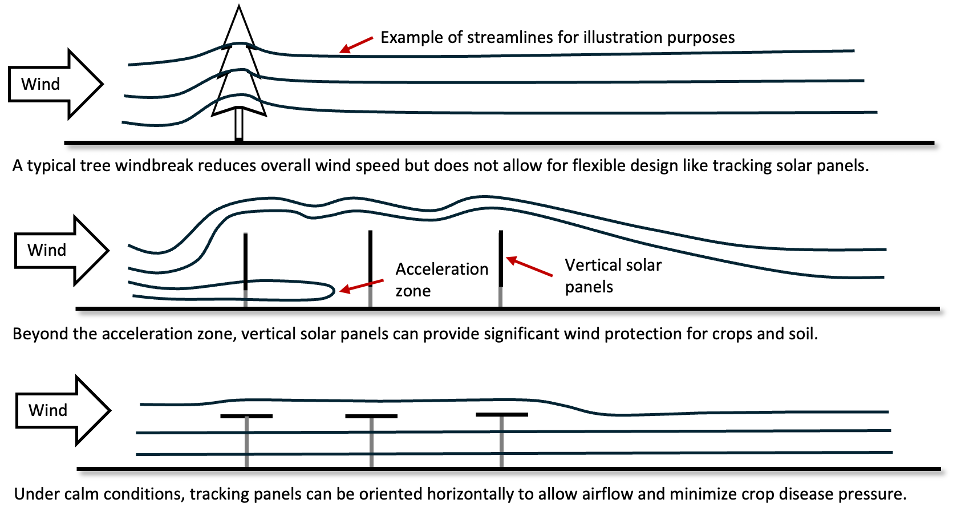
In our recent study published in Agricultural and Forest Meteorology[1], we developed a computational fluid dynamics (CFD) model to quantify the windbreak effect of solar panels in various configurations, demonstrating how different panel orientations can alter airflow underneath. Our simulations show that vertical panels provide excellent protection from high wind speeds for crops and soils in the interior of the agrivoltaics system. There is a tradeoff, however. In the first few rows, an acceleration zone is created from air squeezing into the open space between the ground and the lower edge of the solar panels. This tunneling effect can be minimized by dropping the leading row of solar panels closer to the ground.

At the other extreme, when panels are oriented horizontally, airflow is largely uninhibited below. This can be useful in calm conditions if mildew is a concern for producers.

Above: Illustrative streamlines show how air moves through a tree windbreak, vertical solar panels, and horizontal solar panels.

Our study identifies a shelter zone starting after the acceleration zone. In the shelter zone, crops and soils are largely protected from extreme wind. To maximize windbreak benefits in an agrivoltaics system, crops would be planted in the shelter zone.

Under high inlet wind speeds, our simulations indicate that vertical solar panels can achieve a wind reduction of up to 40% of inlet wind speed in the shelter zone. The tree windbreak in our model only achieves up to 20% reduction in the shelter zone. For extreme wind gusts, the difference between 40% and 20% wind reduction can save crops and soils from major damage. This indicates that vertical solar panels can perform better under the simulated conditions than a row of trees planted as a windbreak.

Overall, these results point to the importance of considering airflow in agrivoltaics designs. When solar installations are designed to control wind conditions, agrivoltaics systems can prevent severe wind damage to crops and soils while also generating revenue for the producer.

Combined with other microclimate alterations in agrivoltaics systems, wind protection from solar panels is a meaningful benefit to crops and soils facing extreme weather conditions.


[1] Henry J. Williams, Khaled Hashad, K. Max Zhang, Agrivoltaics wind shelter benefits with single-axis tracking solar panels, Agricultural and Forest Meteorology, Volume 380, 2026, 111091, ISSN 0168-1923, https://doi.org/10.1016/j.agrformet.2026.111091.

Have a Custom Boundary, Farm, or Corridor in Mind?

Speak directly with our solar infrastructure engineering team in Novato, CA to model boundary generation, wind tolerances, foundation engineering, and financial payback.