Researchers at University of California, Merced, are delving deeper into the potential of solar panels alongside canals, building upon the innovative Project Nexus. This large-scale initiative, spearheaded by the Turlock Irrigation District (TID) in partnership with Solar AquaGrid, is testing the viability of solar canopies above canals for dual benefits: renewable energy generation and water conservation.
UC Merced’s project focuses on vertical solar panels positioned beside the canals, complementing the planned Project Nexus design of overhead canopies. The Sunzaun vertical solar system has the potential to capture sunlight throughout more hours of the day compared to traditional, south-facing panels.
“If we can co-locate our solar panels on our canals we get the benefits of reducing evaporation, reducing aquatic wheat growth and also getting some more solar generation” – Jeremiah Reagan (PhD Student, UC Merced)
Project Nexus holds promise on a grand scale. Estimates suggest California’s 4,000-mile canal network could generate enough solar energy to power millions of homes, while also reducing water evaporation by potentially billions of gallons annually.
This research by UC Merced, along with the overall Project Nexus initiative, paves the way for a revolutionary approach to solar power generation and water conservation in California’s Central Valley and beyond.
We are thrilled to announce the successful installation of Sunzaun’s innovative vertical solar system at Colorado State University’s Agricultural Research, Development, and Education Center (ARDEC). Built by the Colorado-based installer Sandbox Solar, this project is designed to advance agrivoltaic research and features three rows of vertical solar panels with a total capacity of 13.35 kW. Sunzaun delivered the specialized racking material, which ensures the stability and efficiency of the vertical bifacial panels.
The Sunzaun vertical solar system, known for its space-efficient design, leverages bifacial technology to capture sunlight on both sides of the panels, thereby enhancing energy yield. This installation not only generates clean, renewable energy but also serves as a practical example of how solar technology can coexist with agricultural practices, potentially increasing land productivity.
The ARDEC facility will use this installation to explore the benefits of agrivoltaics, including how solar panels can contribute to sustainable farming by providing shade and reducing water evaporation from soil. This collaboration underscores Colorado State University’s commitment to pioneering sustainable solutions in agriculture and energy.
We look forward to the insights and advancements that will emerge from this project, demonstrating the potential of integrating solar power with agricultural operations for a greener and more sustainable future.
Photo Credit: Rutgers Agrivoltaics Program, Rutgers University, New Jersey, USA
The farm at Rutgers University–New Brunswick operates as a hybrid of production farm, research facility and teaching operation in support of the Rutgers School of Environmental and Biological Sciences and Rutgers New Jersey Agricultural Experiment Station related activities. At the farm, students, faculty and staff care for a variety of animals, including sheep, goats and cattle.
Agrivoltaics refers to the use of land for both agriculture and solar energy generation. Placement of an agrivoltaics system in this environment creates a unique opportunity for researching livestock interaction with solar installations. Results from the project will contribute to the Dual-Use Solar Energy Pilot Program that is administered by the New Jersey Board of Public Utilities (NJBPU).
The project was constructed by the New Jersey-based solar energy developer and EPC contractor Advanced Solar Products using Sunzaun’s vertical racking system. “It is one of the first agrivoltaics systems utilizing vertical racking in the northeastern U.S.”, confirms Helge Biernath, CEO and President of Sunstall Inc.
The aim of the project is to investigate the potential benefits of agrivoltaics in a densely populated state with an important agricultural and livestock sector, a large energy demand and limited space to construct renewable energy systems.
The project benefits include:
Innovative Solar Installation: Rutgers selected the Sunzaun vertical solar racking system for its farm facility to minimize obstructions for equipment used to farm the property. The system has a total output capacity of 170 kilowatt Direct Current (kWDC) and consists of 18 rows of 21 panels each mounted in rows running North to South. This means that peak electricity production occurs during the early morning and late afternoon hours when sunlight is received from the East and the West. Two different row spacings and panel mounting heights were used as part of the experimental design.
State-of-the-Art Solar Modules: Rutgers selected ZnShine 450-watt bifacial solar modules with a bifaciality rating of 70 percent. Panel orientation was varied throughout the system (with the primary side facing either east or west), allowing for a determination of the optimum orientation. Power optimizers were installed so that the output of pairs of panels can be tracked, ensuring optimal energy generation and efficiency. These and other bifacial modules are expected to be at the forefront of sustainable energy production for all array types.
Integrated Animal Infrastructure: Since the agrivoltaics system will be used for experiments involving forage production and grazing beef cattle, the design included animal shelters (mostly to create a shade area), animal drinking facilities, and a handling chute for safely managing large animals.
Research and Innovation: Researchers will plant a forage crop in April and will start grazing beef cattle in September. The objective is to study the impacts of the agrivoltaics system on forage production and animal grazing, including any behavioral changes the animals may exhibit when grazing among the panels.
Supporting New Jersey’s Dual-Use Solar Energy Pilot Program: This project will support the Dual-Use Solar Energy Pilot Program that is administered by the NJBPU. The program, spanning a minimum of three years, has a goal to explore the feasibility and benefits of agrivoltaics. It is a collaborative effort with the New Jersey Department of Agriculture and the Rutgers Agrivoltaics Program.
Key features of the Sunzaun vertical racking system include its space saving design, which allows energy production in limited spaces, making it an ideal solution for the generation of solar power on agricultural land, in urban environments and in areas with restricted land availability. The vertical orientation of the panels combines a grid-serving production curve, avoiding the midday peak, with other dual-use benefits such as wind protection, suitability for integrating livestock, and providing shade to crops, possibly resulting in less water consumption and more optimal growing conditions. With the Animal Farm Agrivoltaics Project, Rutgers is leading the way in sustainable agriculture, renewable energy research, and interdisciplinary collaboration and Sunzaun is proud to be a part of it.
The Sunzaun is located on the Somerset Gourmet Farm, a winery in Somerset, CA. 43 bifacial modules with a total power of 23 kW are installed vertically and connected to a microinverter and two batteries. Aztec Solar Inc., a solar energy solutions provider based in Sacramento, CA, made the layout and the electrical design of this site.
The Sunzaun follows the hilly area of the vineyard over 200 feet and supplies the farm with electricity mainly in the morning and in the afternoon. Besides the provided shading this vertical installation enables the farmer to move his harvesters next to the Sunzaun. In this way, winegrowing and the production of renewable energy increase the efficiency of land use.
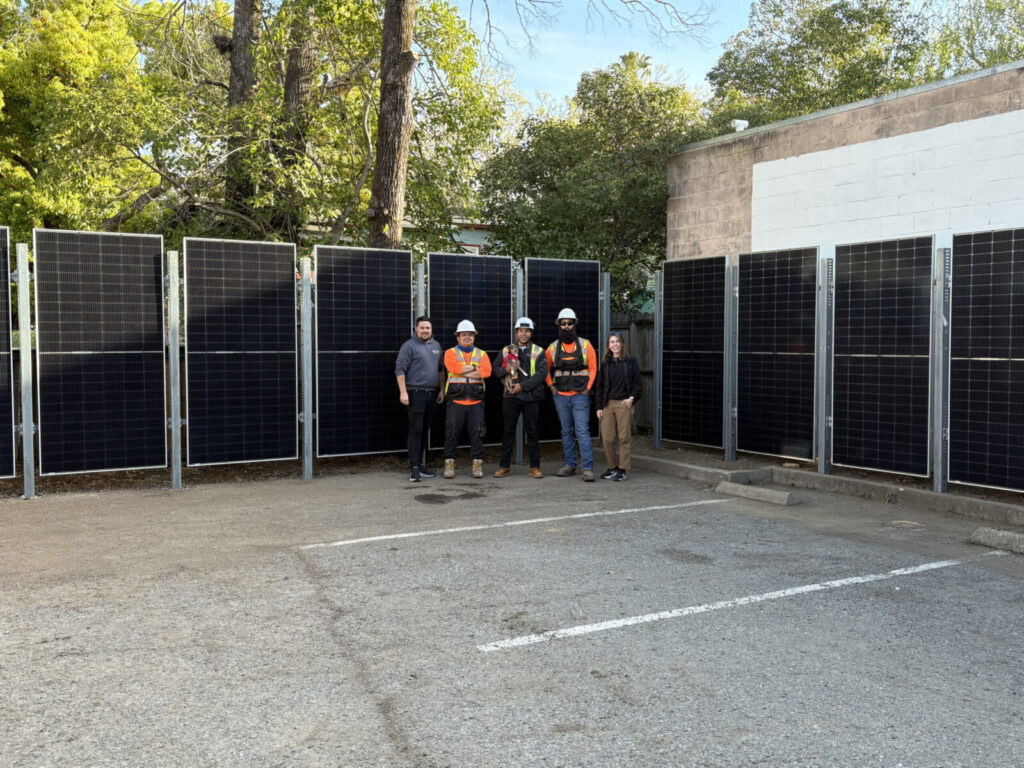
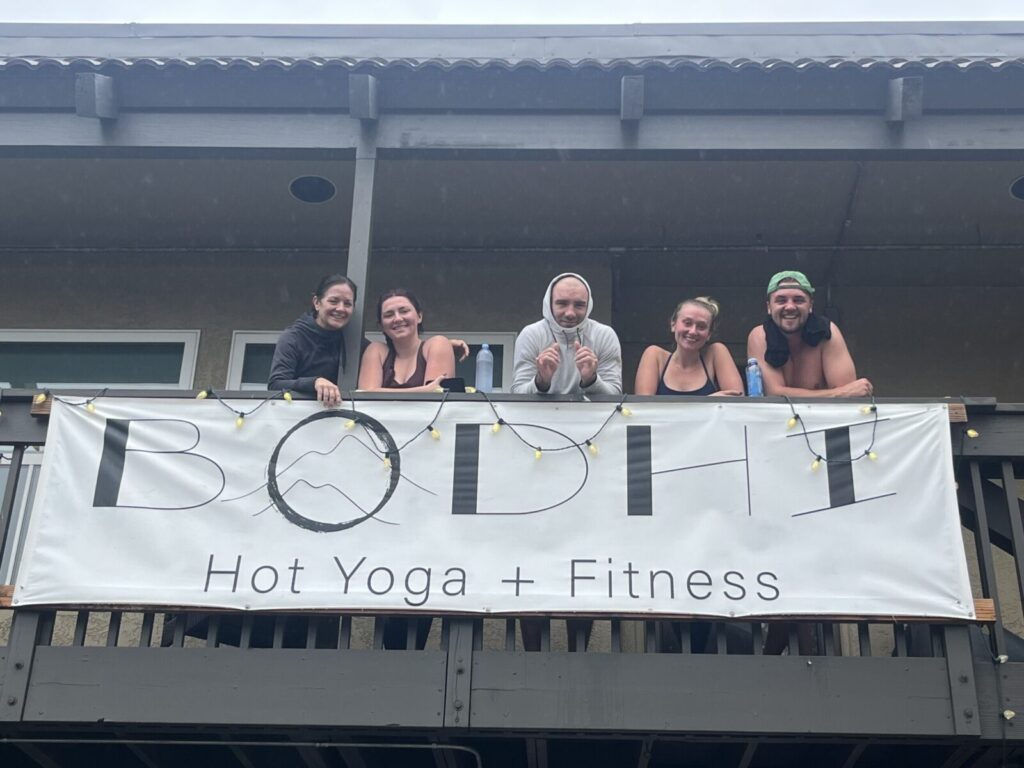
When most people picture a solar installation, they imagine rooftop panels or open fields. Bodhi Hot Yoga & Fitness in central San Rafael, California had neither to offer. What they had was a parking lot perimeter, an electricity bill climbing past $2,000 a month, and a relationship with Sunzaun built on years of shared yoga classes. That combination led to something no urban business in the United States had done before: a vertical bifacial solar installation right in the heart of the city.
How Bodhi Hot Yoga & Fitness in San Rafael, California became the first business in the United States to install a vertical bifacial solar system in an urban environment — and why they’d do it all over again.
“We’re the first, I believe — the first in an urban environment to do it. In the US.” — Bo Keeve, Co-owner, Bodhi Hot Yoga & Fitness
About Bodhi Hot Yoga Bodhi Hot Yoga & Fitness is a family-owned studio run by mother and son Katie and Bo Keeve, with Katie’s husband Damon supporting behind the scenes. Coming up on their second anniversary, Bodhi offers hot yoga, Pilates, and a range of fitness classes using infrared heating panels and added humidity — making it one of the more energy-intensive businesses on its block. The studio was built on four core values: community, boldness, curiosity, and adventurous fun. Those values didn’t just hang on a wall during the solar process. They guided every decision.
The Challenge As an all-electric building with no gas on the property, Bodhi’s energy costs are entirely tied to the grid. In two years of operation, their monthly electricity bill more than doubled — from $500–800 at launch to over $2,000 as class schedules grew and demand increased. Solar had always been on their radar, but the rooftop was structurally complex and every parking space was too valuable to sacrifice. Conventional solar simply didn’t fit.
The Solution Sunzaun proposed something most people had never seen outside of Europe: 16 vertical bifacial panels, each standing eight to nine feet tall, installed along the perimeter of Bodhi’s back parking lot. Bifacial panels capture sunlight from both sides — direct irradiance on one face, reflected and diffuse light on the other — making vertical installation viable without a south-facing rooftop. The design also included a whitened wall section behind the panels to test whether surface reflection could further increase energy yield, a detail that will inform future urban installations. Bodhi Hot Yoga became the first business in the United States to install this type of system in an urban environment.
“They made it easy, they made it affordable, and it’s really fun. I would 100% recommend it.” — Katie Egan, Co-owner
The Construction Process
Katie braced for a month of disruption. The reality was eight to ten days. The Sunzaun crew managed city permitting, utility coordination, and site logistics from start to finish, with no significant involvement required from the owners. Workers kept the site clean daily, attended yoga classes during the build, and Sunzaun co-founder Helge Biernath even brought brewed beer for studio clients inconvenienced by the temporary parking closure. No parking spaces were lost. The bollards added around the panel bases looked, in Katie’s words, “phenomenal.” Bo, who had worried the panels would look industrial and out of place, called the finished result “really cool” and said it fits the lot like a modern perimeter fence.
The Results The system is newly operational and full-year data will tell the definitive story, but projections are clear: $5,000–$10,000 in estimated annual savings on electricity. Zero parking spaces lost. Eight to ten days from start to finish. And a visible, working statement about who Bodhi is as a business — one that clients see every time they pull into the lot.
“Come do hot yoga, support, feel good, enjoy your day. Zero guilt.” — Beau Keeve
San Rafael is growing fast — new buildings rising across the street, eight and seventeen stories high. In that context, a small family-run studio choosing vertical solar isn’t just a financial decision. It’s a declaration about what kind of neighbor they intend to be. For other urban businesses watching their electricity bills climb with no rooftop solution in sight, Bodhi Hot Yoga is proof that a different path exists.
Researchers and landowners face a common challenge with traditional ground-mount solar: standard installations commandeer prime acreage, compact fragile soil, and remove fertile land from active production. In Tennessee, a progressive landowner chose a transformative alternative with Sunzaun’s patented vertical bifacial solar racking to preserve his working farmland while providing 100% off-grid clean energy year-round.
The installation features 4 parallel vertical rows spaced generously to accommodate standard agricultural equipment and tractor passes. Because bifacial solar panels stand upright like a fence line rather than laying tilted over acres of ground, the entire footprint between rows remains completely productive. Sheep and cattle graze freely right up to the panel uprights, while natural pasture grass regenerates uninterrupted.
“By choosing vertical bifacial racking, we didn’t sacrifice a single acre of productive pasture. Our sheep and cattle graze right between the rows, tractors pass freely, and our home remains 100% off-grid across all four seasons.” — Tennessee Homestead & Agricultural Landowner
Paired with an integrated on-site LiFePO4 battery energy storage system, the vertical east-west orientation captures dual peak solar energy during early morning and late afternoon hours—synchronizing electricity generation directly with residential and farm operational demand curves.
Back in 2023, University of California (UC) Davis had a small set of Sunzaun vertical bifacial racking installed – three rows of three modules – to support early agrivoltaics (agriculture + solar, or photovoltaic, energy) research. Sunstall donated the racking system so the university could begin exploring how vertical solar might work alongside crops in California farmland.
Two years later, and after immense collaboration, the research site looks quite different.
A New Research Installation
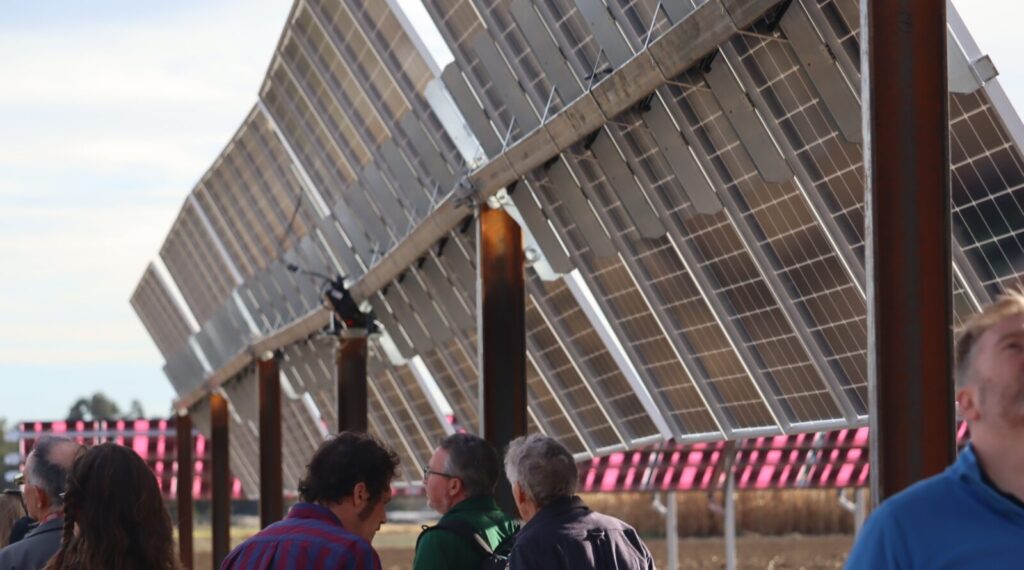
In late October 2025, several solar companies came together to complete a new, and significantly larger, system on one of the campus’s agricultural fields, just across from the original test site. Its completion came just in time for the 3rd Annual California Germany Agrivoltaics Day at UC Davis, organized by German American Chamber of Commerce. This event gathered researchers, farmers, and industry professionals to discuss the progress and potential of agrivoltaics in California, drawing on Germany’s extensive experience in the field. The newly expanded project offered visitors the opportunity to walk through the site, examine the equipment up close, and speak directly with the experts who are building and studying these systems.
The photovoltaic acquisition process was led by Professor Majdi Abou Najm from the Department of Land, Air and Water Resources at UC Davis. He is one of California’s leading figures in agrivoltaics research.
Professor Majdi Abou Najm standing in front of the old Sunzaun installation, surrounded by pepper and basil test crops.
Four Agrivoltaic Systems, One Field
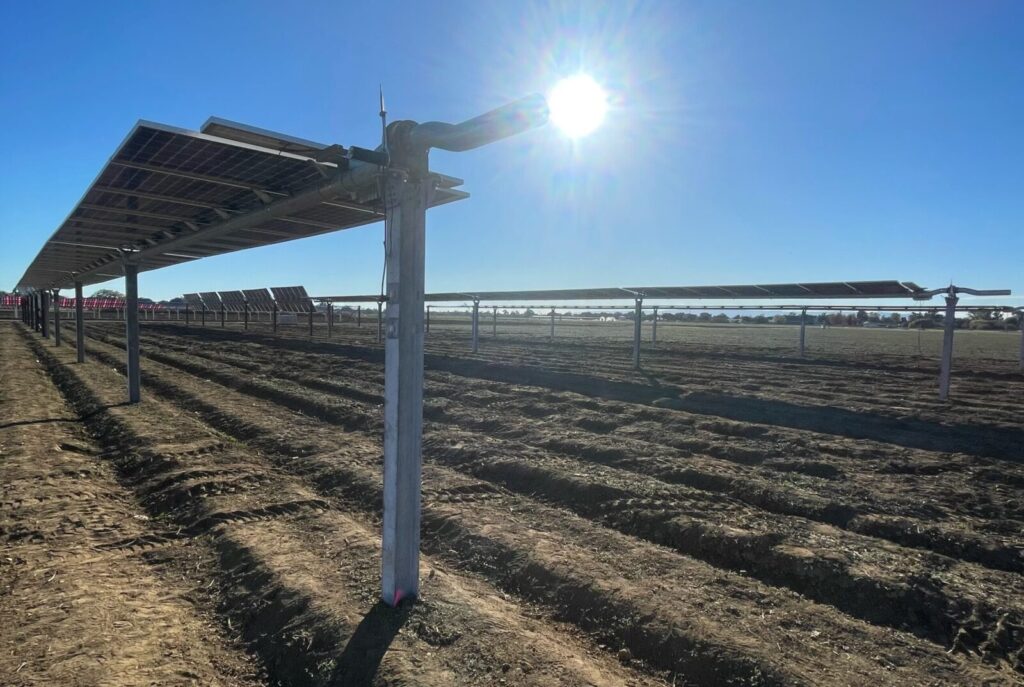
The new research site is unique in its variety. Instead of a single system, the field now hosts four different ground-mounted PV designs, each with its own racking and module configuration. The multi-system format is meant to support decision-making by farmers, developers, and policymakers. comparison that allows researchers to look closely at energy production, crop response, and equipment access. The full site contains 448 modules totaling 200.44 kW.
“This site will inform growers how to select PV systems that align with their needs,” Abou Najm said. “If wind is damaging your crops, vertical systems can help. If heat stress is the issue, spectrally selective panels may be more appropriate,” he said, highlighting how agrivoltaic design choices can be tailored to specific on-farm challenges.
“My hope is to have this facility serve as the technology and science hub for shaping the future of agrivoltaics,” Abou Najm said. “For policy makers, it provides the visual (…) that this is not a one-size-fits-all technology (…), and that if designed with the agriculture-first mindset, can be transformative.”
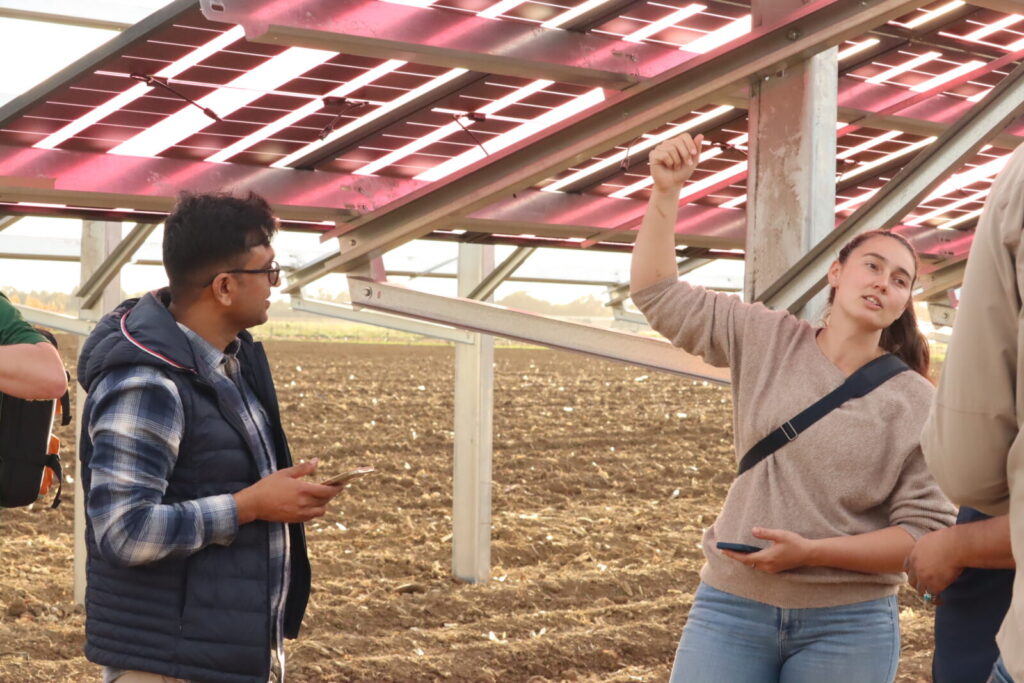
Two commercial tracker design, Nextracker and Nevados, installed next to each other to compare performance and crop impacts. Trackers typically deliver the highest energy yield, and the side-by-side setup gives researchers a rare opportunity to study differences in modules, design, and crop yield.
A fixed-tilt system fitted with red-tinted solar modules. These are spectrally selective modules supplied by Constructive Systems to support plant growth while still generating electricity.
A defining feature of the installation is its approximately 50-foot row spacing; wide enough to accommodate commercial farming equipment. Abou Najm said the spacing was driven by harvesting realities.
“In California, tomato harvesters operate across six rows at a time, alongside trucks collecting the crop,” he said. Tighter spacing would make commercial harvesting inefficient and would ultimately result in more agricultural land being lost to solar.
Over the coming seasons and as funding permits, UC Davis researchers plan to grow tomatoes, among other crops, between PV rows while monitoring crop yield, soil moisture, microclimate effects, carbon sequestration, and operational compatibility.
Installed by Sunstall, Inc.
All four systems were installed by Sunstall Inc., the parent company of Sunzaun and is quickly becoming one of the leading agrivoltaics installation teams in the country. The project highlights Sunstall’s ongoing commitment to supporting universities and research organizations as agrivoltaics shifts from an emerging idea to a tested, practical approach to farming and energy production.
Agrivoltaics has the potential to make food production more resilient while reducing emissions from the electricity sector. Sunzaun is grateful to contribute to this work and looks forward to the research results that will come from UC Davis’s expanded testing ground.
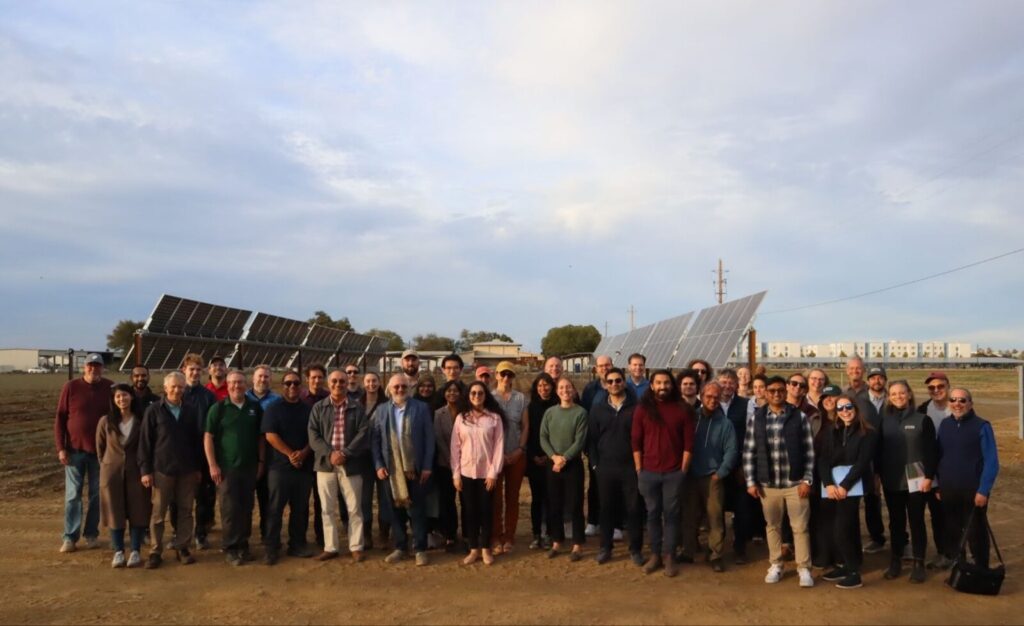
Group photo from the UC Davis Agrivoltaics Day Tour. Photo Credit,Maximilian Dedden
If you’d like to follow updates on vertical solar and agrivoltaics research, please consider joining our Newsletter!
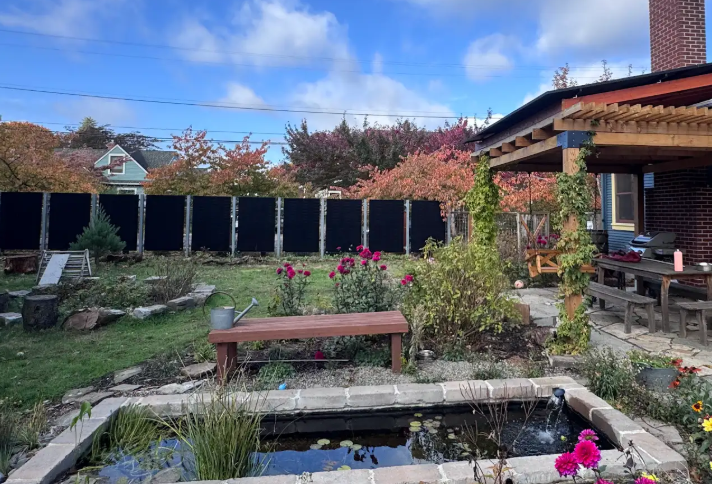
We are thrilled to announce that in July 2025, Sunzaun reached a major milestone! In partnership with Cascade Solar, we completed our very first residential solar fence in Portland, Oregon. This 5.74 kW project features 11 sleek modules, one of the first of its kind in the United States.
The Science Behind the Shine: Technical Advantages
What makes vertical solar panels so effective? Unlike traditional horizontal panels that peak in production only when the sun is directly overhead, vertical bifacial modules capture sunlight from both sides. In regions like the Pacific Northwest, where the sun sits lower in the sky for much of the year, a south-oriented vertical system can significantly optimize energy yield throughout late fall, winter, and early spring. Conversationally, east- and west-facing modules perform best in the summer months. This is the benefit of having perpendicular fencing that allows for a well-rounded energy production curve
Furthermore, vertical panels are naturally more resilient. Their upright position means they shed snow effortlessly and accumulate far less dust and debris than roof-mounted systems. This reduction in “soiling” ensures the panels maintain peak efficiency with minimal maintenance, even during Oregon’s rainy seasons.
Why a solar fence? As energy prices continue to climb, homeowners are looking for smarter ways to power their lives. While rooftop solar is a fantastic option, it isn’t always the perfect fit for every home due to roof orientation or shading. That’s where the “dual-use” revolution comes in. By turning a standard property boundary into a clean energy generator, homeowners can enjoy the benefits of solar without compromising their roofline.
Seamless Integration: A Homeowner’s Dream
For many homeowners, the most compelling reason to go vertical is the installation process. Roof-mounted solar often requires a detailed structural assessment and, in some cases, costly roof reinforcements before installation can even begin. A Sunzaun vertical solar fence, however, is installed as a standalone structure along your property boundary. That means no drilling into your shingles, no modifications to your roof, and no interference with your home’s existing architecture.
Another often-overlooked advantage is long-term maintenance. Roofs don’t last forever, and when it’s time to replace or repair one, rooftop solar panels typically need to be removed and reinstalled; a process that can add thousands of dollars to the cost of roofing work. Because a vertical solar fence is independent of your home infrastructure, roof repairs can be completed without ever touching your solar system, avoiding additional labor costs.
The installation is faster, less invasive, and serves a double purpose: providing privacy and security for your yard while simultaneously slashing your utility bills. It’s a true “plug-and-play” solution for the modern sustainable home.
This project is just the beginning of a useful trend that maximizes space and efficiency. We are incredibly excited to continue our journey with the Cascade Solar team and can’t wait to see what the future of vertical solar brings to neighborhoods across the country!
Ready to Power Your Perimeter?
The era of the smart fence is here, and we want to help you be a part of it. Whether you’re looking to supplement your existing energy source or are just starting your solar journey, vertical solutions offer a unique blend of style and substance.
Are you curious about how a vertical solar fence would look on your property? Reach out to our team today to learn more about our technology and get a custom consultation. Let’s build a brighter, greener future together!
Have a Custom Boundary, Farm, or Corridor in Mind?
Speak directly with our solar infrastructure engineering team in Novato, CA to model boundary generation, wind tolerances, foundation engineering, and financial payback.