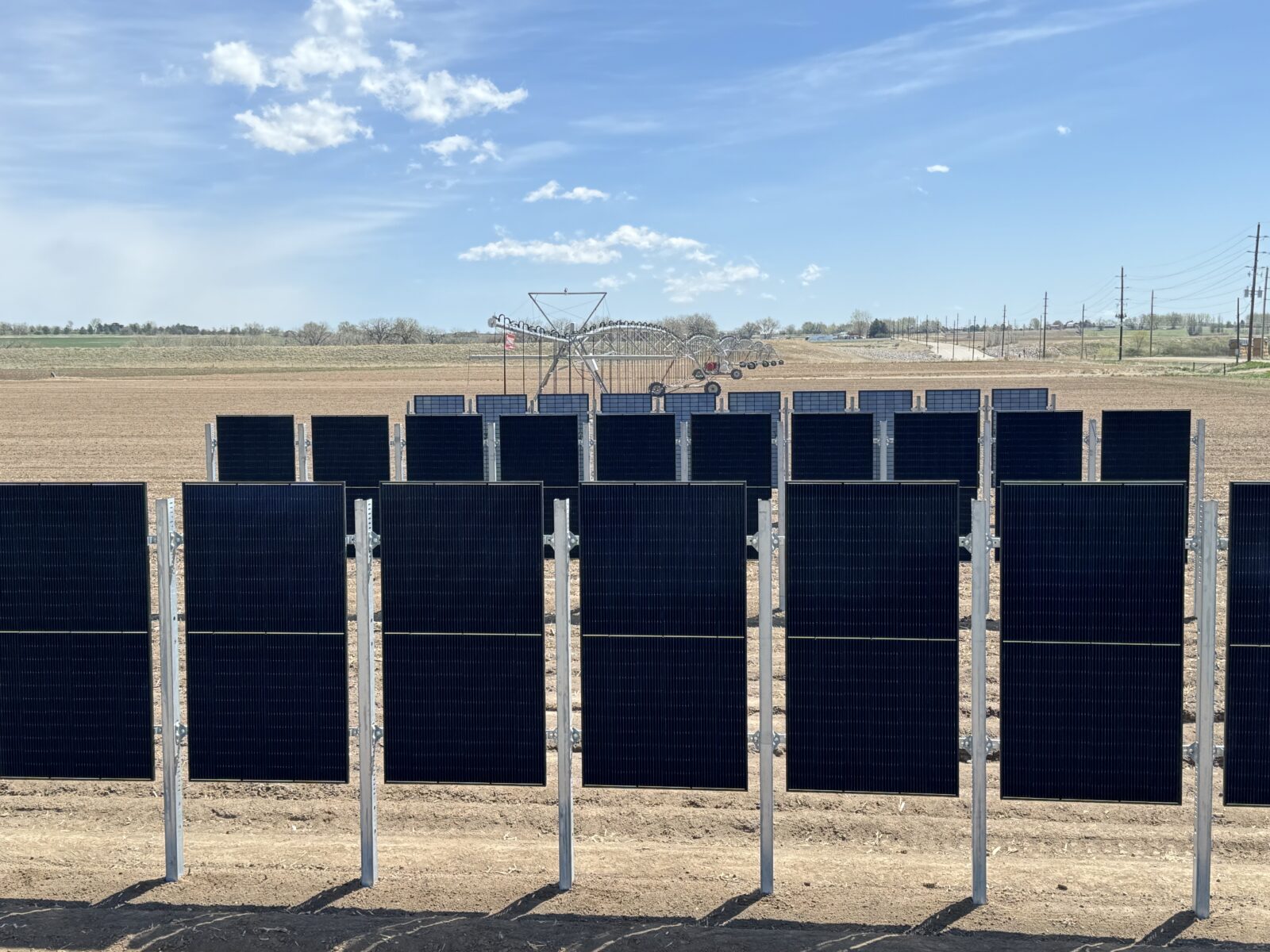
We are thrilled to announce the successful installation of Sunzaun’s innovative vertical solar system at Colorado State University’s Agricultural Research, Development, and Education Center (ARDEC). Built by the Colorado-based installer Sandbox Solar, this project is designed to advance agrivoltaic research and features three rows of vertical solar panels with a total capacity of 13.35 kW. Sunzaun delivered the specialized racking material, which ensures the stability and efficiency of the vertical bifacial panels.
The Sunzaun vertical solar system, known for its space-efficient design, leverages bifacial technology to capture sunlight on both sides of the panels, thereby enhancing energy yield. This installation not only generates clean, renewable energy but also serves as a practical example of how solar technology can coexist with agricultural practices, potentially increasing land productivity.
The ARDEC facility will use this installation to explore the benefits of agrivoltaics, including how solar panels can contribute to sustainable farming by providing shade and reducing water evaporation from soil. This collaboration underscores Colorado State University’s commitment to pioneering sustainable solutions in agriculture and energy.
We look forward to the insights and advancements that will emerge from this project, demonstrating the potential of integrating solar power with agricultural operations for a greener and more sustainable future.
Researchers at University of California, Merced, are delving deeper into the potential of solar panels alongside canals, building upon the innovative Project Nexus. This large-scale initiative, spearheaded by the Turlock Irrigation District (TID) in partnership with Solar AquaGrid, is testing the viability of solar canopies above canals for dual benefits: renewable energy generation and water conservation.
UC Merced’s project focuses on vertical solar panels positioned beside the canals, complementing the planned Project Nexus design of overhead canopies. The Sunzaun vertical solar system has the potential to capture sunlight throughout more hours of the day compared to traditional, south-facing panels.
“If we can co-locate our solar panels on our canals we get the benefits of reducing evaporation, reducing aquatic wheat growth and also getting some more solar generation” – Jeremiah Reagan (PhD Student, UC Merced)
Project Nexus holds promise on a grand scale. Estimates suggest California’s 4,000-mile canal network could generate enough solar energy to power millions of homes, while also reducing water evaporation by potentially billions of gallons annually.
This research by UC Merced, along with the overall Project Nexus initiative, paves the way for a revolutionary approach to solar power generation and water conservation in California’s Central Valley and beyond.
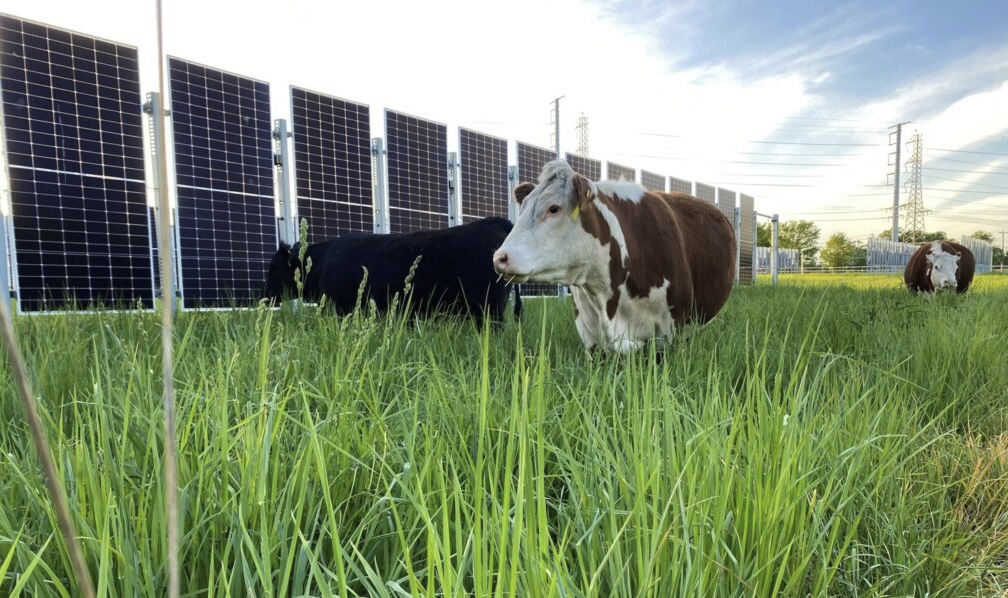
Photo Credit: Rutgers Agrivoltaics Program, Rutgers University, New Jersey, USA
The farm at Rutgers University–New Brunswick operates as a hybrid of production farm, research facility and teaching operation in support of the Rutgers School of Environmental and Biological Sciences and Rutgers New Jersey Agricultural Experiment Station related activities. At the farm, students, faculty and staff care for a variety of animals, including sheep, goats and cattle.
Agrivoltaics refers to the use of land for both agriculture and solar energy generation. Placement of an agrivoltaics system in this environment creates a unique opportunity for researching livestock interaction with solar installations. Results from the project will contribute to the Dual-Use Solar Energy Pilot Program that is administered by the New Jersey Board of Public Utilities (NJBPU).
The project was constructed by the New Jersey-based solar energy developer and EPC contractor Advanced Solar Products using Sunzaun’s vertical racking system. “It is one of the first agrivoltaics systems utilizing vertical racking in the northeastern U.S.”, confirms Helge Biernath, CEO and President of Sunstall Inc.
The aim of the project is to investigate the potential benefits of agrivoltaics in a densely populated state with an important agricultural and livestock sector, a large energy demand and limited space to construct renewable energy systems.
The project benefits include:
Innovative Solar Installation: Rutgers selected the Sunzaun vertical solar racking system for its farm facility to minimize obstructions for equipment used to farm the property. The system has a total output capacity of 170 kilowatt Direct Current (kWDC) and consists of 18 rows of 21 panels each mounted in rows running North to South. This means that peak electricity production occurs during the early morning and late afternoon hours when sunlight is received from the East and the West. Two different row spacings and panel mounting heights were used as part of the experimental design.
State-of-the-Art Solar Modules: Rutgers selected ZnShine 450-watt bifacial solar modules with a bifaciality rating of 70 percent. Panel orientation was varied throughout the system (with the primary side facing either east or west), allowing for a determination of the optimum orientation. Power optimizers were installed so that the output of pairs of panels can be tracked, ensuring optimal energy generation and efficiency. These and other bifacial modules are expected to be at the forefront of sustainable energy production for all array types.
Integrated Animal Infrastructure: Since the agrivoltaics system will be used for experiments involving forage production and grazing beef cattle, the design included animal shelters (mostly to create a shade area), animal drinking facilities, and a handling chute for safely managing large animals.
Research and Innovation: Researchers will plant a forage crop in April and will start grazing beef cattle in September. The objective is to study the impacts of the agrivoltaics system on forage production and animal grazing, including any behavioral changes the animals may exhibit when grazing among the panels.
Supporting New Jersey’s Dual-Use Solar Energy Pilot Program: This project will support the Dual-Use Solar Energy Pilot Program that is administered by the NJBPU. The program, spanning a minimum of three years, has a goal to explore the feasibility and benefits of agrivoltaics. It is a collaborative effort with the New Jersey Department of Agriculture and the Rutgers Agrivoltaics Program.
Key features of the Sunzaun vertical racking system include its space saving design, which allows energy production in limited spaces, making it an ideal solution for the generation of solar power on agricultural land, in urban environments and in areas with restricted land availability. The vertical orientation of the panels combines a grid-serving production curve, avoiding the midday peak, with other dual-use benefits such as wind protection, suitability for integrating livestock, and providing shade to crops, possibly resulting in less water consumption and more optimal growing conditions. With the Animal Farm Agrivoltaics Project, Rutgers is leading the way in sustainable agriculture, renewable energy research, and interdisciplinary collaboration and Sunzaun is proud to be a part of it.
Have a Custom Boundary, Farm, or Corridor in Mind?
Speak directly with our solar infrastructure engineering team in Novato, CA to model boundary generation, wind tolerances, foundation engineering, and financial payback.