Green Fields, Clean Energy: 4 Takeaways from the 1st California Germany Agrivoltaics Conference

Exploring the intersection of agriculture and renewable energy, the recent California Germany Agrivoltaics Conference at University of California, Davis, provided a platform for experts, researchers, and enthusiasts to delve into the groundbreaking fusion of solar technology and farming practices. Amidst the discussions and presentations, four standout takeaways emerged, illuminating the potential of agrivoltaics in revolutionizing our approach to land use, energy generation, and sustainable food production. Join us as we uncover the key insights gleaned from this enlightening conference and their implications for a more resilient and eco-friendly future and how California and Germany can learn from each other.

1. There Will Be 9 Billion People – The World Needs Resilient Farming

As the world population steadily grows, the impacts of climate change present a significant challenge to food production, potentially disrupting agricultural stability and raising concerns about global food security. This is also reflected in the United Nations Sustainable Development Goals, the following of which recognize the importance of a resilient food supply:

  • Zero Hunger (The food demand will increase by 60% until 2050)
  • Clean Water and Sanitation (Worldwide a 40% higher water demand is expected)
  • Affordable and Clean Energy (The energy demand will grow by 50%)
  • Sustainable Cities and Communities (In 2050 there will be 2 Billion more urbanites)

The nexus of food, water, and energy represents the interconnected relationship between these vital resources, highlighting the dependency and impact each has on the others. Agrivoltaics emerges as a promising solution within this nexus, offering a harmonious convergence between agricultural productivity, renewable energy generation, and efficient water usage. By integrating solar panels within agricultural spaces, agrivoltaics enables the dual use of land, maximizing its utility. 

“There is a lot to learn from the European experience, we don’t need to reinvent the wheel”

Majdi Abou Najm, Associate Professor of Soil Biophysics at University of California, Davis

The shade provided by solar panels reduces water evaporation, fostering a more conducive environment for crops while concurrently generating clean energy. This approach optimizes land use, mitigates water scarcity issues, and bolsters renewable energy production, offering a sustainable pathway to address the challenges at the intersection of food, water, and energy. Through agrivoltaics, the synergy between these essential resources can be harnessed to create a more resilient and environmentally conscious system. In addition to the enormous potential, the implementation of this innovative approach also poses a number of challenges, but there is “a lot to learn from the European experience, we don’t need to reinvent the wheel” says Majdi Abou Najm, Associate Professor of Soil Biophysics at University of California, Davis.

2. Europe Is Far Ahead – The U.S. Should Catch Up Soon

European countries have been increasingly adopting this innovative approach to address land use challenges and bolster renewable energy production. Countries like Germany, France, Spain, and the Netherlands have implemented agrivoltaic systems, utilizing farmland to simultaneously generate solar energy and cultivate crops. These initiatives showcase the potential for dual land use, optimizing land productivity and contributing to the region’s renewable energy goals. As Europe continues to prioritize sustainability, agrivoltaics stands as a promising pathway towards achieving energy targets while supporting agricultural resilience in the face of changing environmental dynamics.

“We need to bring it out of the labs at the universities into the world and deploy it like a product”

Sebastian Wicklein, Director, Business Development and R&D Coordination at Fraunhofer USA Inc.

In Germany for instance, the Fraunhofer Institute’s APV-Obstbau (Orcharding) research project focuses on the development and implementation of photovoltaic systems specifically for orchards. The aim is to make optimum use of agricultural land by installing solar systems above the fruit trees. This innovative method not only enables the simultaneous production of renewable energy and the management of orchards, but also aims to protect the plants from extreme weather conditions. The project takes a holistic approach to maximize orchard yields, increase energy efficiency and promote sustainability in agriculture. The research conducted by the Fraunhofer Institute as part of the APV Fruit Growing project has the potential to transform the future of agricultural practices by combining innovative solutions to the challenges of producing food and renewable energy.

At University of California Davis, researchers have set up a test field where diverse plant species are grown under varying light conditions (read our blog article here). The field is equipped with light filters that record relevant data throughout the plant growth process. At the core of the research conducted by Prof. Majdi Abou Najm’s team is the question, how agrivoltaics can help conserve irrigation water and boost crop yield while providing renewable energy for the country.

3. Partnerships and Community Engagement are Key

Effective partnerships between researchers, solar developers, farmers, and policy makers are pivotal in driving innovation, optimizing land use, fostering sustainable practices, and shaping policies that integrate agrivoltaics seamlessly into agricultural landscapes for a greener future. It is just as important to involve local communities in the process in order to create acceptance and concepts that really work.

UC Davis agrivoltaics research project with Sunzaun installation

Community engagement for agrivoltaics involves fostering an inclusive dialogue and collaboration among local stakeholders, farmers, policymakers, and residents. It starts by educating and raising awareness within the community about the benefits and potential of agrivoltaics. Workshops, town hall meetings, and informational sessions can serve as platforms to share knowledge, address concerns, and gather feedback. Encouraging participation in the planning and implementation phases allows community members to voice their opinions, preferences, and needs, ensuring that agrivoltaic projects align with local contexts. Moreover, establishing transparent communication channels fosters trust and empowers the community to actively contribute to decision-making processes. Collaborative initiatives, such as community-owned agrivoltaic installations or profit-sharing models, can further solidify community engagement by providing direct involvement and economic benefits. Ultimately, a well-engaged community becomes an integral part of successful agrivoltaic projects, promoting sustainability, local support, and shared benefits for all involved parties.

4. We are in the Beginning of a 5th Agricultural Revolution

The history of mankind goes hand in hand with revolutionary developments in the way we do agriculture. Each agricultural revolution has brought about significant changes in farming methods, technology, and food production, shaping human societies and economies across different historical periods. Here is a short overview:

  • First Agricultural Revolution (10,000 BCE): This revolution marked the transition from hunting and gathering to settled agricultural communities.
  • Second Agricultural Revolution (17th to 19th century): The second revolution was characterized by advancements in agricultural technology and practices. Introduction of improved machinery and pesticides significantly increased agricultural productivity.
  • Green Revolution (Mid-20th Century): High-yielding varieties of crops, increased use of chemical fertilizers, pesticides, and improved irrigation methods were introduced. These innovations led to a dramatic increase in crop yields.
  • Precision Agriculture (Late 20th century to present): This revolution emphasizes the integration of technology and data-driven approaches into agriculture.

Agrivoltaics as a 5th revolution?

Agrivoltaics represents a potential paradigm shift in agriculture and energy production that could indeed be considered a potential fifth agricultural revolution due to its transformative impact. Creating dual use efficiency, optimizing resource utilization, enhancing sustainability and economic viability of farming mean a lot of potential transformation.

Agrivoltaics can make a significant contribution to strengthening agriculture against the challenges of the climate crisis, ensuring food security for a growing world population and at the same time supporting the ecological and social transformation through the expansion of renewable energies.

LATEST INSIGHTS & RESEARCH

stay ahead with

vertical solar innovation

California produces nearly half of all U.S. vegetables and more than three-quarters of U.S. fruits and nuts, according to the CDFA. Today, moving that food from farms and packing facilities to distribution centers, ports, and markets requires a significant transportation network. One that runs predominantly on diesel.

Shifting this transportation network from diesel to electricity could have significant environmental and public-health benefits. A recent Southern California study found that battery-electric trucks produced approximately 75% fewer well-to-wheel greenhouse gas emissions than comparable diesel trucks, while eliminating tailpipe emissions such as nitrogen oxides (NOx) and particulate matter. These pollutants have been linked to respiratory and cardiovascular disease, as well as premature death.

But electrifying heavy-duty transportation also creates substantial new electricity demand. As electric trucks such as the Tesla Semi enter commercial fleets, larger questions appear: Where will that electricity come from, and could innovative solar infrastructure along transportation lines become part of the solution?

The Energy Economics Can Be Compelling

Consider a simplified example of a heavy-duty truck operating predictable routes in California’s Central Valley.

If a truck travels approximately 300 miles per day for 250 days each year, it covers about 75,000 miles annually. Based on Tesla’s claim that the electric Class 8 truck requires approximately 2 kWh per mile, including allowances for charging losses and operating conditions, it would consume roughly 150 MWh of electricity per year. California’s average electricity prices during the first half of 2026 were approximately $0.20/kWh for industrial customers and $0.26/kWh for commercial customers, according to the U.S. Energy Information Administration. That represents approximately $30,000–$39,000 per year in electricity costs.

A comparable diesel tractor averaging 6.3 mpg would consume approximately 11,900 gallons of diesel annually over the same 75,000 miles. At California’s August 2026 average on-highway diesel price of approximately $7.04 per gallon, annual fuel costs would approach $84,000. Under these assumptions, electrification could save roughly $45,000–$54,000 per truck per year in energy costs alone.

Actual economics will vary considerably with diesel and electricity prices, vehicle efficiency, charging losses, demand charges, payload, route conditions, and other factors. But the simplified calculation illustrates something important: for predictable agricultural trucking routes, the cost of electricity itself may not be the biggest obstacle. The greater challenge may be ensuring sufficient electricity is available along delivery routes and at the time trucks need to charge.

Truck Electrification Means More Energy Infrastructure

Heavy-duty charging requires infrastructure on an entirely different scale than passenger EV charging. A packing facility, distribution center, or trucking depot operating dozens of electric trucks could require several megawatts of charging capacity. In rural areas, delivering that power may require utility upgrades, transformers, switchgear and other costly infrastructure.

This makes predictable agricultural routes particularly interesting. A truck that travels between a packing facility and distribution center and returns to the same yard each day has something an unpredictable long-haul truck does not: a known place and time to charge.

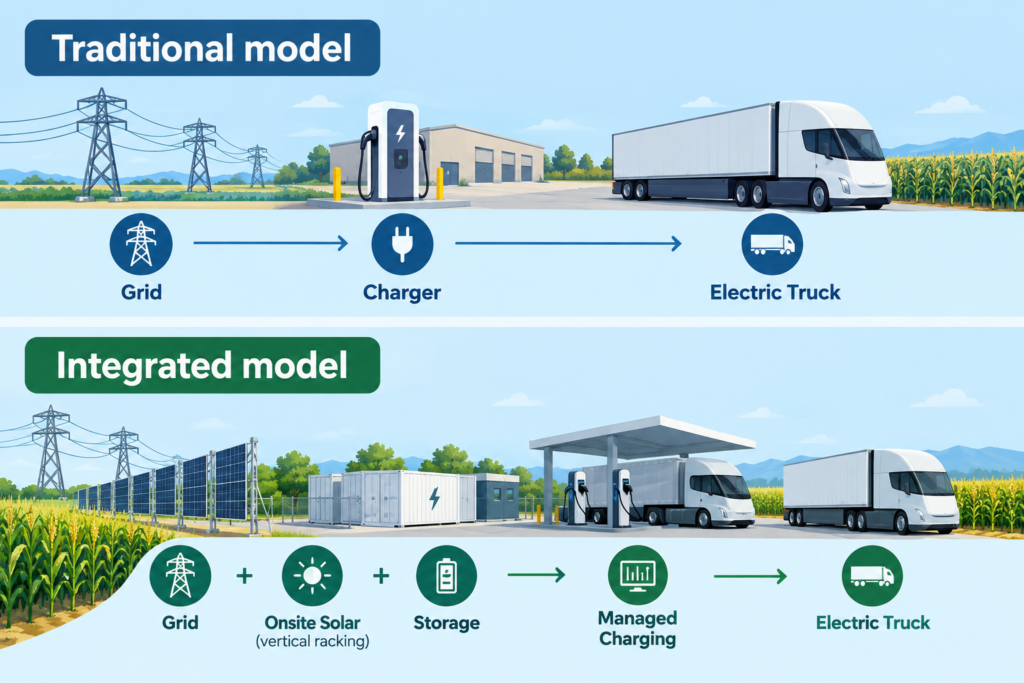
That opens the door to pairing charging with onsite generation and energy storage. Rather than relying solely on the traditional model of grid-supplied charging, facilities could move toward a more integrated approach where renewable energy, such as solar, is paired with battery storage and managed charging.

This allows electricity generated onsite to be stored when production exceeds immediate demand and delivered later when trucks need to charge. In addition to increasing the use of onsite renewable energy, storage can help reduce peak demand on the grid, manage demand charges, and smooth large charging loads that might otherwise require substantial utility infrastructure upgrades. For fleet operators, the result could be greater control over when and how electricity is purchased, generated, stored, and ultimately delivered to vehicles.

Where Does Highway Solar Fit In?

While direct connections could be technically possible in certain locations, there are significant practical challenges. Electricity generated alongside a highway is not automatically available to a truck charger several miles away. Interconnection, ownership, utility requirements, DOT right-of-way restrictions, and the mismatch between variable solar generation and megawatt-scale truck charging all affect whether and how that electricity can be used.

Highway solar should therefore be viewed more broadly as a potential distributed generation resource within an increasingly electrified transportation system, rather than a direct connection between a particular solar array and a particular truck.

The Role of Dual-Use Solar

Conventional ground-mounted solar can contribute to this energy mix, but in agricultural regions such as the central valley, arable land is a valuable and finite resource. Dedicating additional acreage exclusively to energy production can create competition between renewable energy development and food production.

That is where dual-use energy systems with a small footprint, such as vertical PV, enter the conversation. Rather than replacing the existing use of the land, vertical solar can be integrated along agricultural plots as wind breaks, property boundaries as fencing, and other narrow or underutilized spaces. In the right applications, these systems can add renewable generation without taking working land out of production.

Conceptual illustration generated using AI.

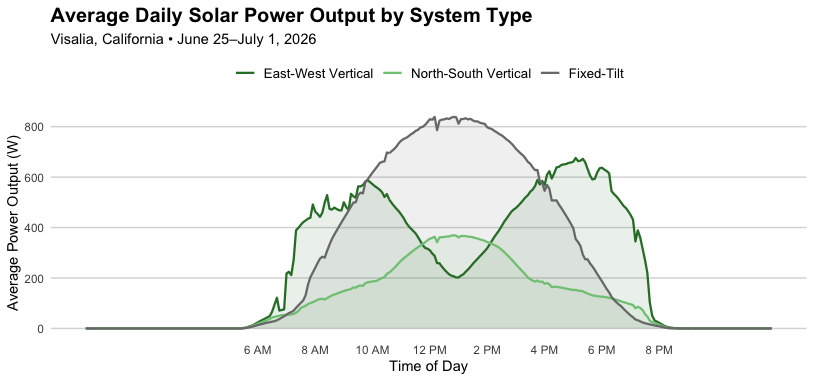
Vertical bifacial PV also has a different daily production profile than conventional south-facing fixed-tilt solar. An east-west-facing vertical array tends to produce more strongly during the morning and afternoon, with lower production around solar noon relative to a traditional array. For transportation facilities, that profile could have advantages. Trucks returning to a depot later in the day  may begin charging during afternoon or evening hours. West-facing surfaces of a vertical bifacial system can continue generating later in the day, potentially placing more solar production closer to those charging periods.

That does not eliminate the need for the grid or battery storage. Heavy-duty trucks require large amounts of energy, and charging schedules will rarely align perfectly with solar generation. But it demonstrates why transportation solar should be evaluated on more than annual kilowatt-hours alone. 

The Future of Property Lines

California’s Central Valley offers a compelling setting for transportation electrification: high diesel costs, abundant solar resources, and predictable and highly frequented freight routes. As trucks increasingly shift from diesel to electricity, the infrastructure that supports those routes will need to evolve as well. That creates an opportunity to look beyond conventional solar sites and consider spaces already present in the agricultural and transportation landscape.

By finding productive uses for the spaces between farms, freight facilities, and freeways, the Central Valley could help demonstrate how transportation electrification and distributed solar generation can grow together.

Annual energy production has long been the primary metric used to compare photovoltaic (PV) configurations. In general, configurations that produce more kilowatt-hours are assumed to perform better. However, electricity is not worth the same amount throughout the day.

Many utilities now use Time-of-Use (TOU) rate structures, where the value of electricity varies by time of day. Under these tariffs, electricity generated during periods of high demand, which is typically in the late afternoon and evening, has a higher economic value than electricity generated during lower-priced periods.

As solar deployment has increased, midday electricity has become increasingly abundant in many markets. In regions such as California, this can reduce the value of electricity generated around noon while increasing the value of generation later in the day. As a result, a PV configuration that produces less total energy may still generate greater economic value if its generation profile better aligns with higher-value periods.

As electricity markets continue to evolve, evaluating PV configurations requires considering not only how much electricity is produced, but also when it is produced.


How Vertical East-West Configurations Differ

Conventional fixed-tilt PV configurations are designed to maximize annual energy production, with generation peaking around solar noon when solar irradiance is highest.

Vertical east-west bifacial configurations produce a different generation profile. Because bifacial modules generate electricity from both faces, the east-facing side captures more morning sunlight while the west-facing side produces more electricity later in the day. This shifts generation away from midday and creates two distinct production peaks—one in the morning and one in the late afternoon.

Measuring the Value of Electricity

To better understand how generation timing affects economic value, we evaluated measured production data from three PV configurations using a representative 2026 PG&E Time-of-Use (TOU) tariff. This allowed us to compare not only how much electricity each configuration produced, but also when it was produced and the corresponding value of that electricity.

The three configurations included an east-west vertical system, a north-south vertical system, and a 20° fixed-tilt system. Each system used identical PV modules and microinverters.

The analysis sought to answer three questions:

  • Which PV configuration produces the most electricity?
  • Which PV configuration generates the greatest share of its electricity during the highest-value TOU periods?
  • Which PV configuration provides the greatest overall economic value under a TOU rate structure?

Initial Findings

Measured field data collected over five representative days in June 2026 revealed a clear difference between energy production and energy value.

Although the fixed-tilt system produced the most electricity, the east-west vertical system generated the greatest economic value. This difference was driven by generation timing. Because the east-west vertical configuration produced a larger share of its electricity during higher-value TOU periods, each kilowatt-hour generated was worth more on average.

  • Fixed Tilt: Produced the most electricity (32.2 kWh), but only 14.3% of its energy was generated during peak-rate hours. Its average electricity value was 34.3¢/kWh, which serves as the baseline for comparison.

  • East-West Vertical: Produced slightly less electricity (29.2 kWh), approximately 9.3% below fixed tilt, but generated 35.4% of its energy during peak-rate hours. As a result, its electricity averaged 40.6¢/kWh, which is approximately 18% more value per kilowatt-hour than the fixed-tilt system.

  • North-South Vertical: Produced substantially less electricity (13.3 kWh). Its average electricity value (35.4¢/kWh) was slightly higher than fixed tilt, but its lower energy production resulted in the lowest overall economic value ($4.71).

The lower performance of the north-south vertical configuration is consistent with the reduced direct solar exposure expected for north-south-oriented vertical systems during summer. Monitoring is ongoing to evaluate seasonal performance throughout the year.

Overall, these initial results highlight that the configuration that produced the most electricity was not the configuration that produced the greatest economic value. Under Time-of-Use pricing, when electricity is generated can be just as important as how much is generated.

Why This Matters

These findings illustrate that maximizing annual energy production does not necessarily maximize economic value.

In regions where solar energy is well established, midday electricity is becoming increasingly abundant, reducing its value during certain periods of the year. At the same time, electricity demand, and often electricity prices, remain higher during the late afternoon and early evening. Under these conditions, a generation profile that shifts production away from solar noon may provide greater economic value, even if total energy production is lower.

As Time-of-Use pricing becomes more common, evaluating PV configurations requires considering both how much electricity is generated and the time at which it is generated. Depending on the utility tariff and site characteristics, a generation profile that better aligns with higher-value periods may provide benefits beyond project revenue, including reduced grid stress, lower reliance on peaker plants, and improved utilization of renewable generation.

Project Considerations

These results do not indicate that vertical east-west PV configurations will always provide greater economic value. Performance depends on several project-specific factors, including:

  • Utility Time-of-Use tariff structure
  • Geographic location
  • Seasonality and weather
  • PV system design
  • On-site electricity consumption versus grid export

Utilities with relatively small differences between peak and off-peak electricity prices may show only modest economic differences between PV configurations. Conversely, tariffs with larger price differentials may place greater value on generation that occurs outside the midday production peak.

Applications with significant morning or late-afternoon electricity demand may benefit most from this generation profile, including:

  • Agricultural irrigation operating under TOU tariffs
  • Farms with electrically driven water pumps
  • Commercial or industrial facilities with morning and evening demand peaks
  • Projects seeking to reduce demand charges
  • PV systems paired with battery energy storage

Conclusion

Annual energy production remains an important measure of PV performance, but it does not always capture the full economic value of a system. As Time-of-Use electricity pricing becomes more widespread, generation timing is becoming an increasingly important consideration alongside total energy production. This analysis demonstrates that, under the representative utility tariff evaluated, the vertical east-west bifacial configuration produced greater economic value despite generating less total electricity than the conventional fixed-tilt configuration. Evaluating both energy production and energy value provides a more complete basis for comparing PV configurations and selecting the most appropriate solution for a given project.


Analysis based on production data collected from Sunzaun’s Central Valley, California test site. Results represent an initial five-day analysis from June and should not be generalized across all projects or seasons. The system configurations and utility rate structures may vary depending on location, weather, utility tariffs, and project-specific design.


About the Author

Anika conducted the data analysis and prepared this article. She is part of the Business Development team at Sunzaun, where she focuses on vertical solar technologies, agrivoltaics, and research that supports practical solar deployment.

How Bodhi Hot Yoga & Fitness in San Rafael, California became the first business in the United States to install a vertical bifacial solar system in an urban environment — and why they’d do it all over again.

“We’re the first, I believe — the first in an urban environment to do it. In the US.”
— Bo Keeve, Co-owner, Bodhi Hot Yoga & Fitness

When most people picture a solar installation, they imagine rooftop panels or open fields. Bodhi Hot Yoga & Fitness in central San Rafael, California had neither to offer. What they had was a parking lot perimeter, an electricity bill climbing past $2,000 a month, and a relationship with Sunzaun built on years of shared yoga classes. That combination led to something no urban business in the United States had done before: a vertical bifacial solar installation right in the heart of the city.

About Bodhi Hot Yoga
Bodhi Hot Yoga & Fitness is a family-owned studio run by mother and son Katie and Bo Keeve, with Katie’s husband Damon supporting behind the scenes. Coming up on their second anniversary, Bodhi offers hot yoga, Pilates, and a range of fitness classes using infrared heating panels and added humidity — making it one of the more energy-intensive businesses on its block. The studio was built on four core values: community, boldness, curiosity, and adventurous fun. Those values didn’t just hang on a wall during the solar process. They guided every decision.

The Challenge
As an all-electric building with no gas on the property, Bodhi’s energy costs are entirely tied to the grid. In two years of operation, their monthly electricity bill more than doubled — from $500–800 at launch to over $2,000 as class schedules grew and demand increased. Solar had always been on their radar, but the rooftop was structurally complex and every parking space was too valuable to sacrifice. Conventional solar simply didn’t fit.

The Solution
Sunzaun proposed something most people had never seen outside of Europe: 16 vertical bifacial panels, each standing eight to nine feet tall, installed along the perimeter of Bodhi’s back parking lot. Bifacial panels capture sunlight from both sides — direct irradiance on one face, reflected and diffuse light on the other — making vertical installation viable without a south-facing rooftop. The design also included a whitened wall section behind the panels to test whether surface reflection could further increase energy yield, a detail that will inform future urban installations. Bodhi Hot Yoga became the first business in the United States to install this type of system in an urban environment.

“They made it easy, they made it affordable, and it’s really fun. I would 100% recommend it.” — Katie Egan, Co-owner

The Construction Process

Katie braced for a month of disruption. The reality was eight to ten days. The Sunzaun crew managed city permitting, utility coordination, and site logistics from start to finish, with no significant involvement required from the owners. Workers kept the site clean daily, attended yoga classes during the build, and Sunzaun co-founder Helge Biernath even brought brewed beer for studio clients inconvenienced by the temporary parking closure. No parking spaces were lost. The bollards added around the panel bases looked, in Katie’s words, “phenomenal.” Bo, who had worried the panels would look industrial and out of place, called the finished result “really cool” and said it fits the lot like a modern perimeter fence.

The Results
The system is newly operational and full-year data will tell the definitive story, but projections are clear: $5,000–$10,000 in estimated annual savings on electricity. Zero parking spaces lost. Eight to ten days from start to finish. And a visible, working statement about who Bodhi is as a business — one that clients see every time they pull into the lot.

“Come do hot yoga, support, feel good, enjoy your day. Zero guilt.” — Beau Keeve

San Rafael is growing fast — new buildings rising across the street, eight and seventeen stories high. In that context, a small family-run studio choosing vertical solar isn’t just a financial decision. It’s a declaration about what kind of neighbor they intend to be. For other urban businesses watching their electricity bills climb with no rooftop solution in sight, Bodhi Hot Yoga is proof that a different path exists.

Is vertical solar right for your property?

Have a Custom Boundary, Farm, or Corridor in Mind?

Speak directly with our solar infrastructure engineering team in Novato, CA to model boundary generation, wind tolerances, foundation engineering, and financial payback.